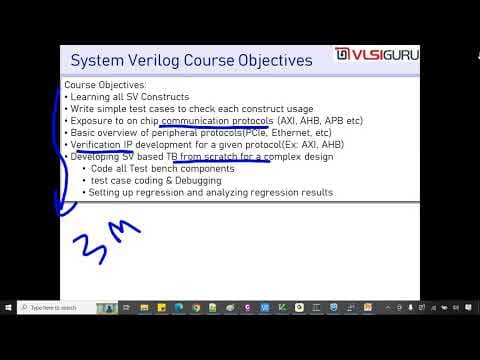
System Verilog Course is a 9-week intensive course covering System Verilog constructs, advanced verification techniques, and 200+ industry examples with hands-on labs.
Next Batch
1-1 Dedicated Mentor Support
24/7 Tool Access
Multiple Mock Interviews
Industry Standard Projects
Support with Resume Update
System Verilog Course Overview
Course Overview
System Verilog training is a 9 weeks course provides in-depth exposure to all the language constructs. Each and every session emphasizes on providing practical use cases for all constructs. Course includes 15+ assignments with dedicated lab sessions to support with the assignment completion.
System Verilog Training course is provides participants with exposure to advanced functional verification techniques including constrained random verification, assertion based verification, and coverage based verification. The course is targeted for engineers with all experience levels, starting from a BE, ME fresher to experienced engineers. System Verilog Training course is also targeted for engineers working in non-VLSI domains and planning to switch in to VLSI. Learning starts from basic examples to entire test bench development coding, to ensure a smooth learning curve.
System Verilog language in learnt using more than 200+ detailed examples covering all aspects of SV starting from data types, operators, OOPs(Classes), Arrays, Inter-process synchronization, Interface, Program, constraints and randomization, code coverage, functional coverage, DPI and assertions. These examples cover more than 90% of questions asked in VLSI interviews.
System Verilog Training course also involves 18 detailed assignments. These assignments are prepared by industry experts covering all aspects of SV from language constructs. Student gets to work on these assignments with complete guidance from trainers.
Functional Verification overview
- Test bench architecture
- Test bench components
- Test bench development : Modularity, Reusability
- Understanding Functional Verification flow
System Verilog Course overview
- System Verilog language features
- Verilog for TB development
- Verilog Language constructs and shortcomings
operators, data types
- Literals
- Operators – How things change from Verilog
- Data types
- Integer based
- string
Arrays
- Array classification
- Packed and Unpacked Arrays
- Static and Dynamic Arrays
- Multi dimensional Arrays
- Dynamic Arrays
- Associative Arrays
- Queue
- Array of Queues in scoreboard implementation, other complex declarations
Object Oriented Programming
- Basics of OOP
- Class, Object, handle
- Class elements
- Properties, methods, constraints
- Properties – 5 attributes in property declaration
- rand/randc, signed, static, 2/4 state, data hiding
- Language provided and User defined methods
- Developing Ethernet frame and APB Tx class
- new constructor
- randomize, pre_randomize, post_randomize
- User defined methods – print, copy, compare, pack, unpack
- Encapsulation – Data hiding, local, protected, public
- Inheritance
- Ethernet frame generation example to learn OOP
- Polymorphism – real life usecases
- this, super
- Class forward declaration
- Multiple levels of inheritance
- Abstract class
- Parameterized classes
- Difference from Verilog parameterization
- Parameterization with inheritance – 4 combinations
- Parameterized classes for testbench development
- Static properties and methods
- Interface class
- Constant class property
- Scope resolution operator
- Nested class
- Variable scope
- Object copying – copy by handle, shallow copy, deep copy
- $cast – static and dynamic casting
Advanced data types
- Data types
- Chandle, event, typedef, struct, union, enum
- Using struct data type for medals tally sorting example
- Typedef for defining complex data types
- Using complex data types in scoreboard development
Fork join, Inter process synchronization
- Labeling
- Fork join – join_any, join, join_none
- Nested fork
- Labeling fork
- Process, process states
- Inter process synchronization
- IPS constructs – mailbox, event, Semaphore
- mailbox – types, methods
- events – persistant, synchronization examples
- Semaphore – synchronization examples
Project to learn all SV language constructs
- Project – Memory TB development covering 90% of SV language constructs
- Configurable memory TB development
- Interface – Ports, internal signals, clocking block, modport
- using clocking block to fix design – TB synchronization issues
- Physical interface, virtual interface
- Using interface for design and TB connection
Program
- Program significance
- How Program differs from Module
- Why Program is redundant?
Scheduling semantics
- Scheduling semantics
Task, Function
- Task, function – how they are different from Verilog
- Static & automatic task/functions
- System task and functions
Constraints
- Constraints format
- Constraints type
- Simple
- distribution
- implication
- if-else
- iterative
- variable ordering
- soft
- unique
- Inline constraints
- Constraints for queue randomization
- Constraints virtual nature
Randomization
- Randomization in class, module
- rand, randc
- randcase
- Multiple hands on examples on Constraints and Randomization
- Chip select example using multiple inter related constraints
- new significance for randc
- Constrained random verification
- Directed verification
Functional coverage
- What is functional coverage?
- Need for functional coverage
- Where FC comes in functional verification flow?
- How to implement FC?
- Different types of FC?
- Integrating Functional coverage in Test bench
- functional coverage hierarchy
- Different types of coverpoints – simple, cross, transition
- Different types of bins – normal, illegal, ignore
- coverage calculation
- coverage options
- auto_bin_max
- weigth
- at_least
- goal
- comment
- name
- per_instance
- detect_overlap
- Listing down cover points for a design
- Instance coverage
- Cross coverage with intersect
- FC system task & Functions
- Coverage Driven Verification
- Coverage report analysis
- Cover groups with arguments
- Coverage filter using iff
- Functional coverage types in TB
- transaction class coverage
- register field coverage
- scenario coverage
Code coverage
- Generating code coverage
- Different types – FCBEST
- FSM
- Conditional
- Branch
- Expression
- Statement
- Toggle
- Detailed understanding of code coverage types with examples
Coverage report analysis
- Merging UCDBs, generating coverage reports
- Analyzing coverage report
- Coverage exclusion
Assertions and Assertion based verification
- Need for assertions?
- Assertion based verification
- Types of assertions
- Immediate assertions
- Concurrent assertions
- Assertion format – antecedent, consequent
- Running assertions using questasim, debugging the assertions in waveform
- Assertion hierarchy – property, sequence, boolean expression
- ##, |-> and |=> operators
- Assertion examples for clock frequency check
- Assertion with local variables
- Assertions for simple timing diagrams
- Listing down and implementing assertions for simple designs
- Async FIFO
- Interrupt controller
DPI
- Direct Programming Interface(DPI)
- import and export of functions
Configuration libraries, Packages, XMR
- Configuration Libraries
- Incremental compilation
- Packages – defining, importing
- XMR
Remaining SV topics
- Compiler directives
- Macros
- Parameterizable macros
- VCD – value change dump
- common array methods
- Callbacks – multiple use case examples


Key Features

Who All Can Attend This System Verilog Course?
This System Verilog course welcomes BE/ME freshers and experienced engineers aiming to master advanced verification techniques for VLSI or transitioning from non-VLSI domains.Pre-requisites To Take System Verilog Course
- Verilog & Digital Design
- Exposure to coding design & testbench using Verilog (Ex: FIFO design & verification using Verilog)

High Demand for System Verilog Course
Know about the Growing VLSI industry
Responsible for creating UVM-based testbenches, developing verification plans, writing test cases, and ensuring that the RTL design meets all functional requirements.
Over 70% of semiconductor companies require UVM skills for verification roles.
UVM-trained verification engineers are 40% more likely to be hired for high-budget projects.
Verification roles contribute to 60% of hiring demand in front-end VLSI design teams.
₹6 LPA
₹9 LPA
₹14 LPA
₹20 LPA
₹28 LPA


Mode of Training
Next Batch
1-1 Dedicated Mentor Support
24/7 Tool Access
Multiple Mock Interviews
Industry Standard Projects
Support with Resume Update

- Learn in real-time with instructor-led sessions
- Flexible access from anywhere
- Recorded sessions available for revision
- Training on industry-standard tools
- Get certification after completion

- Self-paced learning as per your flexibility
- Industry-aligned learning modules
- Certification after course completion
- Access to structured video lessons and materials
- Track your progress step by step
- Access to learning materials for more than 1.5 years
This 9-week System Verilog course offers in-depth learning of all language constructs with practical use cases and 15+ supported assignments. It exposes participants to advanced verification techniques like constrained random and assertion-based verification. Targeted at all experience levels, including freshers and those switching to VLSI, the course uses 200+ examples covering crucial interview topics and 18 expert-designed assignments for comprehensive skill development.

Career Path
Learning Path


At VLSIGuru, we believe that education should lead to meaningful employment. Our training programs are designed not just to impart technical excellence, but also to bridge the gap between academic learning and industry demands. With a strong network of hiring partners and a proven track record, we ensure that our students are career-ready.
Placement Highlights

Projects
Below is the list of projects student will be doing as part of the training. Student will be working on the same project starting from the scratch.
By working on below projects, student will get familiar with:
- Industry standard simulation tools like Questasim & VCS
- Debug expertise
- TB development
- Industry-aligned curriculum
- Hands-on projects and case studies
- Communication skills
- Resume building and interview preparation
- Technical and HR mock sessions
- Aptitude and domain-specific test series
- Regular drives and exclusive hiring events with partner companies
- Resume building and interview preparation

At VLSIGURU, we provide industry-focused VLSI training and guidance that helps students and professionals build strong technical skills and succeed in their careers. Our programs are designed to be practical, flexible, and aligned with current industry requirements.


Student Reviews




Frequently Asked Questions
- Course presentations for all topics
- Session notes
- Lab documents with detailed steps
- User guides
- Institute philosophy : 'Quality education at affordable fee'. All courses are structured to make them affordable for everyone to undergo training.
- Low cost does not mean low quality course; our SV training course is amongst the best SV training course available.
- Verilog & Digital Design
- Exposure to coding design & testbench using Verilog (Ex: FIFO design & verification using Verilog)
- Each aspect of course is supported by lot of practical examples
- Ethernet switch design used as reference design from Session#1 towards implementing and learning SystemVerilog constructs
- All SystemVerilog course examples, AXI VIP, and Memory Controller Verification environment implemented from scratch as part of sessions
- Dedicated full day lab sessions to ensure student gets complete hands on exposure
- It is possible to cover whole SV training content including projects in 10 weeks(extended by 1 week if required). This will also require student also to spend dedicated time every week to revise the course topics and complete assignments as per schedule.
- 50 batches of SV training is completed so far since we started in 2012.
Each session of course is recorded, missed session videos will be shared
- Yes, You will have option to view the recorded videos of course for the sessions missed
- You will have option to repeat the course any time in next 1 year
Yes, you will get the support even after course completion
Plan for 8-10 hours weekly to grasp concepts well and complete assignments effectively.
Yes, VLSI Guru offers flexible weekend and evening batches to suit your work schedule seamlessly.
Absolutely! VLSI Guru emphasizes extensive hands-on labs for practical SystemVerilog mastery.
You can aim for roles like Junior Verification Engineer, ASIC Verification Intern, and FPGA Verification Trainee.
It will add valuable verification skills, making you a more versatile and sought-after professional.
Expect growth towards Senior Verification Engineer, Verification Lead, and Architect roles.
Entry-level salaries are competitive, with significant growth based on experience and skills.
Yes, SystemVerilog expertise is highly valued, leading to substantial salary growth.
More experience combined with SystemVerilog skills directly translates to higher earning potential.
You'll gain expertise in testbench creation, assertion-based verification, and constrained random testing.
Definitely! VLSI Guru provides comprehensive training in building robust SystemVerilog testbenches.
Yes, the course introduces fundamental UVM concepts essential for modern verification.

© 2025 - VLSI Guru. All rights reserved
Explore a wide range of VLSI and Embedded Systems courses to get industry-ready.
50+ industry oriented courses offered.

Explore a wide range of VLSI and Embedded Systems courses to get industry-ready.
50+ industry oriented courses offered.