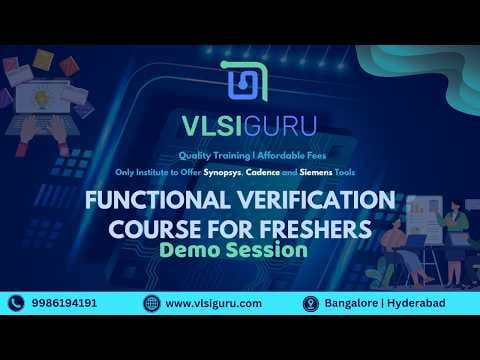
AI-Integrated VLSI Design & Functional Verification Course with 8 months of industry-focused training. Gain hands-on experience in SystemVerilog, UVM, and Functional Verification using Synopsys VCS & Verdi, Mentor Questasim, and Cadence Xcelium tools.
Next Batch
1-1 Dedicated Mentor Support
24/7 Tool Access
Multiple Mock Interviews
Industry Standard Projects
Support with Resume Update
AI Driven VLSI Design and Verification Course Overview
The AI-Driven VLSI Design and Verification Course is an advanced 8-month industry-oriented training program designed to give fresh graduates and engineering students comprehensive, hands-on expertise across all major domains of VLSI front-end design and verification — including RTL design, functional verification, digital design, SystemVerilog verification, UVM-based verification, SoC verification, protocol verification, and AI-assisted semiconductor workflows.
This program is one of the most complete VLSI front-end courses for freshers, structured to build strong practical skills across the entire semiconductor front-end domain — from foundational digital design and RTL coding to advanced chip-level functional verification and AI-driven debug methodologies.
What Makes This Course Different
Fresh graduates entering the VLSI and semiconductor industry consistently face the same critical skill gaps — weak fundamentals in RTL design, Verilog HDL coding, advanced digital design, and front-end functional verification. This course directly addresses all of these gaps through an intensive, assignment-driven curriculum covering:
- RTL Design & Coding — industry-standard RTL design using Verilog HDL with 25+ real-world coding examples
- Functional Verification — end-to-end functional verification methodology from testbench architecture to coverage closure
- Front-End Verification — complete front-end VLSI verification flow including simulation, waveform analysis, and RTL debug
- SystemVerilog Verification — advanced verification language constructs with 200+ practical coding examples
- UVM-Based Verification — Universal Verification Methodology, UVC development, and protocol-level verification
- SoC Design & Verification — system-on-chip architecture, integration, and SoC-level functional verification
- Protocol Verification — verification of industry-standard on-chip protocols including AXI, AHB, USB, PCIe, DDR, and more
- ASIC Verification Flow — RTL-to-signoff verification flow understanding for ASIC front-end roles
- RTL Debugging — schematic tracing, waveform debug, simulation analysis, and testbench issue resolution
- AI-Assisted Verification Workflows — modern AI tools for functional verification productivity, debug automation, and script generation
- Digital Design Verification — timing analysis, CDC verification, setup and hold checks, and timing violation resolution
- Scripting & Automation for Verification — Python and PERL automation for VLSI verification environments
Comprehensive & Practical Training
The entire course is built around hands-on learning — every module includes coding exercises, RTL debugging tasks, verification assignments, and industry-oriented projects. Student progress is continuously evaluated through 75+ detailed assignments covering Digital Design, ASIC Flow, RTL Coding, Verilog, SystemVerilog, UVM, Functional Verification, RTL Debug, SoC Verification, Linux/UNIX, and Python/PERL scripting.
Dedicated soft skills and semiconductor interview preparation training is included to help students build technical communication confidence and perform well in VLSI design and verification interviews at leading semiconductor companies.
Who Should Take This Course
This AI-Driven VLSI Design and Verification Course is the right choice for:
- Fresh graduates and engineering students targeting front-end VLSI roles in RTL design, functional verification, or SoC verification
- Freshers with no prior VLSI experience looking to build strong foundations in digital design, RTL coding, and verification from scratch
- Engineers from non-VLSI domains planning to transition into semiconductor front-end, chip design, or verification careers
- Students targeting ASIC verification, SoC verification, or protocol verification roles at semiconductor product and fabless companies
Available in both classroom and online modes, this course provides a fully structured, industry-aligned learning path into the VLSI front-end design and verification domain.
Mentor Graphics, Questasim, Synopsys VCS


Key Features

Who All Can Attend This AI Driven VLSI Design and Verification Course?
This course is designed for individuals aspiring to build or enhance a career in semiconductor design and verification. Whether you're just starting out or transitioning from related domains, it equips you with industry-relevant skills and tools.Pre-requisites To Take Functional / ASIC Verification
- No Pre-requisites, as the course covers all aspects from scratch.

High Demand for Functional / ASIC Verification
Know about the Growing VLSI industry
This is a crucial role focused on ensuring that the integrated circuit (IC) design works correctly before manufacturing. You'll be involved in creating test plans, developing test environments using languages like SystemVerilog and methodologies like UVM, running simulations, and finding and fixing design bugs. This role requires strong analytical and problem-solving skills, as well as a keen eye for detail. You'll work closely with the design engineers throughout the process.
₹4 LPA
₹6.5 LPA
₹7.5 LPA
₹9.5 LPA
₹11.5


The semiconductor industry continues to demand engineers who are not just theoretically sound but practically skilled in real-time design and verification environments. A job oriented VLSI design and verification program bridges this gap by combining structured learning with hands-on exposure to industry workflows.
For fresh graduates, especially from ECE and EEE backgrounds, enrolling in a design and verification course for freshers is one of the most effective ways to transition into core VLSI roles. Programs that include a 6 months verification internship program provide a deeper understanding of real project cycles, enabling learners to confidently work on RTL design, debugging, and verification environments.
VLSI DV (Design Verification) and RTL Training
A strong industry-oriented VLSI design verification curriculum focuses on real-world challenges faced by semiconductor companies. Instead of just theory, learners work on practical VLSI design and DV projects, covering areas like RTL coding, testbench development, and debugging methodologies.
Courses that offer SystemVerilog UVM training with placement prepare candidates for advanced verification roles, making them industry-ready from day one. Similarly, a functional verification course with placement ensures that learners gain expertise in writing scalable and reusable verification environments.
Whether you choose an online VLSI design verification course or prefer offline VLSI design and verification training, the emphasis should always be on practical exposure, project-based learning, and tool-based implementation.
Best VLSI Placement Training for Freshers
A major advantage of enrolling in a verification course with internship or verification internship with training is the opportunity to gain hands-on experience while learning. Programs that combine training with internship with placement for ECE freshers significantly improve job readiness.
Freshers often struggle to enter the VLSI domain due to lack of experience. That’s where an ASIC verification internship for freshers or an RTL design internship with placement plays a critical role. These programs simulate real industry environments, helping candidates build confidence and practical skills.
Designed for Freshers and Engineering Students
For engineering graduates, especially those searching for the best VLSI course for freshers, it’s important to choose a program that aligns with current industry requirements. A VLSI DV course for engineering students should include both design fundamentals and verification methodologies.
Courses that offer VLSI training for ECE students and VLSI training for EEE students ensure that learners from different backgrounds can adapt to frontend design and verification roles. A well-structured VLSI frontend and DV course covers RTL design, simulation, debugging, and verification techniques in a cohesive manner.
Frontend Design and Verification Course with Placement-Focused Training
A VLSI course with placement is not just about learning, it’s about getting hired. The most effective programs integrate technical training with interview preparation, resume building, and mock interviews.
If you’re aiming for a VLSI design & verification placement course, look for training that includes real-time projects, internship exposure, and placement assistance. A verification training for freshers with placement ensures that candidates are fully prepared to handle interviews and job responsibilities.
Build a Career in ASIC Design and Verification
The demand for professionals trained in ASIC design and verification continues to grow. Enrolling in an ASIC verification course with placement or a VLSI design and verification certification program opens doors to roles in semiconductor companies, design service firms, and product-based organizations.
Whether you are searching for a VLSI DV course near me or a flexible online job-orientedd VLSI design verification course, the right training program can accelerate your career growth. A VLSI training institute for placements that focuses on practical learning, internship exposure, and job readiness can make a significant difference in your career journey.
Start Your VLSI Career with Confidence
Choosing the right VLSI design and verification course with placement is the first step toward a successful career in the semiconductor industry. With a combination of VLSI internship with design verification, hands-on projects, and structured learning, you can build the skills required to succeed in frontend design and verification roles.
A comprehensive VLSI design and verification training program not only equips you with technical expertise but also prepares you for real-world challenges, making you industry-ready from day one.

Explore a wide range of VLSI and Embedded Systems courses to get industry-ready.
50+ industry oriented courses offered.

Explore a wide range of VLSI and Embedded Systems courses to get industry-ready.
50+ industry oriented courses offered.