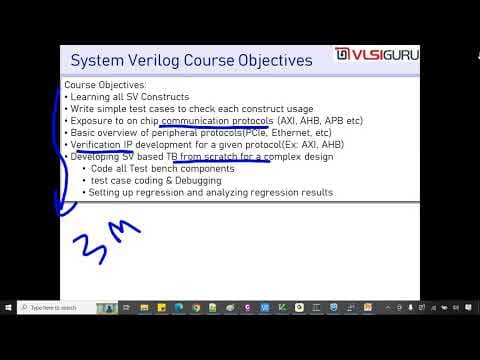
System Verilog Course is a 9-week intensive course covering System Verilog constructs, advanced verification techniques, and 200+ industry examples with hands-on labs.
Next Batch
1-1 Dedicated Mentor Support
24/7 Tool Access
Multiple Mock Interviews
Industry Standard Projects
Support with Resume Update
System Verilog Course Overview
Course Overview
System Verilog training is a 9 weeks course provides in-depth exposure to all the language constructs. Each and every session emphasizes on providing practical use cases for all constructs. Course includes 15+ assignments with dedicated lab sessions to support with the assignment completion.
System Verilog Training course is provides participants with exposure to advanced functional verification techniques including constrained random verification, assertion based verification, and coverage based verification. The course is targeted for engineers with all experience levels, starting from a BE, ME fresher to experienced engineers. System Verilog Training course is also targeted for engineers working in non-VLSI domains and planning to switch in to VLSI. Learning starts from basic examples to entire test bench development coding, to ensure a smooth learning curve.
System Verilog language in learnt using more than 200+ detailed examples covering all aspects of SV starting from data types, operators, OOPs(Classes), Arrays, Inter-process synchronization, Interface, Program, constraints and randomization, code coverage, functional coverage, DPI and assertions. These examples cover more than 90% of questions asked in VLSI interviews.
System Verilog Training course also involves 18 detailed assignments. These assignments are prepared by industry experts covering all aspects of SV from language constructs. Student gets to work on these assignments with complete guidance from trainers.
Functional Verification overview
- Test bench architecture
- Test bench components
- Test bench development : Modularity, Reusability
- Understanding Functional Verification flow
System Verilog Course overview
- System Verilog language features
- Verilog for TB development
- Verilog Language constructs and shortcomings
operators, data types
- Literals
- Operators – How things change from Verilog
- Data types
- Integer based
- string
Arrays
- Array classification
- Packed and Unpacked Arrays
- Static and Dynamic Arrays
- Multi dimensional Arrays
- Dynamic Arrays
- Associative Arrays
- Queue
- Array of Queues in scoreboard implementation, other complex declarations
Object Oriented Programming
- Basics of OOP
- Class, Object, handle
- Class elements
- Properties, methods, constraints
- Properties – 5 attributes in property declaration
- rand/randc, signed, static, 2/4 state, data hiding
- Language provided and User defined methods
- Developing Ethernet frame and APB Tx class
- new constructor
- randomize, pre_randomize, post_randomize
- User defined methods – print, copy, compare, pack, unpack
- Encapsulation – Data hiding, local, protected, public
- Inheritance
- Ethernet frame generation example to learn OOP
- Polymorphism – real life usecases
- this, super
- Class forward declaration
- Multiple levels of inheritance
- Abstract class
- Parameterized classes
- Difference from Verilog parameterization
- Parameterization with inheritance – 4 combinations
- Parameterized classes for testbench development
- Static properties and methods
- Interface class
- Constant class property
- Scope resolution operator
- Nested class
- Variable scope
- Object copying – copy by handle, shallow copy, deep copy
- $cast – static and dynamic casting
Advanced data types
- Data types
- Chandle, event, typedef, struct, union, enum
- Using struct data type for medals tally sorting example
- Typedef for defining complex data types
- Using complex data types in scoreboard development
Fork join, Inter process synchronization
- Labeling
- Fork join – join_any, join, join_none
- Nested fork
- Labeling fork
- Process, process states
- Inter process synchronization
- IPS constructs – mailbox, event, Semaphore
- mailbox – types, methods
- events – persistant, synchronization examples
- Semaphore – synchronization examples
Project to learn all SV language constructs
- Project – Memory TB development covering 90% of SV language constructs
- Configurable memory TB development
- Interface – Ports, internal signals, clocking block, modport
- using clocking block to fix design – TB synchronization issues
- Physical interface, virtual interface
- Using interface for design and TB connection
Program
- Program significance
- How Program differs from Module
- Why Program is redundant?
Scheduling semantics
- Scheduling semantics
Task, Function
- Task, function – how they are different from Verilog
- Static & automatic task/functions
- System task and functions
Constraints
- Constraints format
- Constraints type
- Simple
- distribution
- implication
- if-else
- iterative
- variable ordering
- soft
- unique
- Inline constraints
- Constraints for queue randomization
- Constraints virtual nature
Randomization
- Randomization in class, module
- rand, randc
- randcase
- Multiple hands on examples on Constraints and Randomization
- Chip select example using multiple inter related constraints
- new significance for randc
- Constrained random verification
- Directed verification
Functional coverage
- What is functional coverage?
- Need for functional coverage
- Where FC comes in functional verification flow?
- How to implement FC?
- Different types of FC?
- Integrating Functional coverage in Test bench
- functional coverage hierarchy
- Different types of coverpoints – simple, cross, transition
- Different types of bins – normal, illegal, ignore
- coverage calculation
- coverage options
- auto_bin_max
- weigth
- at_least
- goal
- comment
- name
- per_instance
- detect_overlap
- Listing down cover points for a design
- Instance coverage
- Cross coverage with intersect
- FC system task & Functions
- Coverage Driven Verification
- Coverage report analysis
- Cover groups with arguments
- Coverage filter using iff
- Functional coverage types in TB
- transaction class coverage
- register field coverage
- scenario coverage
Code coverage
- Generating code coverage
- Different types – FCBEST
- FSM
- Conditional
- Branch
- Expression
- Statement
- Toggle
- Detailed understanding of code coverage types with examples
Coverage report analysis
- Merging UCDBs, generating coverage reports
- Analyzing coverage report
- Coverage exclusion
Assertions and Assertion based verification
- Need for assertions?
- Assertion based verification
- Types of assertions
- Immediate assertions
- Concurrent assertions
- Assertion format – antecedent, consequent
- Running assertions using questasim, debugging the assertions in waveform
- Assertion hierarchy – property, sequence, boolean expression
- ##, |-> and |=> operators
- Assertion examples for clock frequency check
- Assertion with local variables
- Assertions for simple timing diagrams
- Listing down and implementing assertions for simple designs
- Async FIFO
- Interrupt controller
DPI
- Direct Programming Interface(DPI)
- import and export of functions
Configuration libraries, Packages, XMR
- Configuration Libraries
- Incremental compilation
- Packages – defining, importing
- XMR
Remaining SV topics
- Compiler directives
- Macros
- Parameterizable macros
- VCD – value change dump
- common array methods
- Callbacks – multiple use case examples


Key Features

Who All Can Attend This System Verilog Course?
This System Verilog course welcomes BE/ME freshers and experienced engineers aiming to master advanced verification techniques for VLSI or transitioning from non-VLSI domains.Pre-requisites To Take System Verilog Course
- Verilog & Digital Design
- Exposure to coding design & testbench using Verilog (Ex: FIFO design & verification using Verilog)

High Demand for System Verilog Course
Know about the Growing VLSI industry
Responsible for creating UVM-based testbenches, developing verification plans, writing test cases, and ensuring that the RTL design meets all functional requirements.
Over 70% of semiconductor companies require UVM skills for verification roles.
UVM-trained verification engineers are 40% more likely to be hired for high-budget projects.
Verification roles contribute to 60% of hiring demand in front-end VLSI design teams.
₹6 LPA
₹9 LPA
₹14 LPA
₹20 LPA
₹28 LPA


Hyderabad, often referred to as the "HITEC City," is a thriving hub for technology and engineering professionals in India. With the increasing demand for digital design and verification in the semiconductor industry, proficiency in System Verilog has become essential for aspiring engineers. Our System Verilog Course in Hyderabad is meticulously designed to equip participants with the knowledge and skills required to excel in this domain. The comprehensive curriculum covers both theoretical aspects and practical applications, ensuring that students gain a robust understanding of System Verilog's features, including assertions, coverage, and interfaces.
Our System Verilog Training Institute in Hyderabad takes pride in offering a state-of-the-art learning environment, supported by experienced instructors who bring a wealth of industry knowledge to the classroom. The training is tailored for both beginners and experienced professionals looking to enhance their skillset. We also offer System Verilog Online and Offline Training in Hyderabad, allowing you the flexibility to choose a format that best suits your learning preferences. This versatility makes our training accessible to a wider audience, whether you're a student, a working professional, or someone looking to switch careers.
Job-Oriented System Verilog Course in Hyderabad for Career Growth
Given the competitive job market in the field of VLSI design and verification, a Job-Oriented System Verilog Course in Hyderabad stands out as an invaluable opportunity for those looking to boost their employability. Our curriculum is specifically designed in collaboration with industry experts to ensure that it meets current market demands. Participants will engage in hands-on projects and real-time simulations, which are crucial for gaining practical experience. By completing this course, you will not only enhance your technical skills but also improve your confidence in tackling complex design and verification challenges.
What sets us apart as a premier System Verilog Institute in Hyderabad is our commitment to student success. We pride ourselves on having a dedicated placement assistance program that ensures our graduates are job-ready. By enrolling in our Placement Guarantee System Verilog Training in Hyderabad, you are choosing a path that includes resume-building workshops, mock interviews, and direct connections to leading companies in the industry. Our extensive network with top employers provides a significant edge, giving our students opportunities to secure lucrative positions in renowned organizations.
Enroll Now in the Best System Verilog Course Academy in Hyderabad
Joining the best System Verilog Course Academy in Hyderabad is your first step toward building a prosperous career in the ever-evolving world of technology. Our training programs are not just about imparting knowledge; they are designed to foster innovation, critical thinking, and problem-solving abilities essential for today's engineering challenges. The interactive learning environment encourages students to collaborate on projects, share insights, and learn from each other's experiences.
If you are seeking System Verilog training in Hyderabad that is job-oriented and backed by a strong placement guarantee, look no further. Our commitment to your success is evident in our strategic partnerships with leading tech companies and our dedicated training faculty. Don't miss out on the opportunity to advance your career; enroll today and take the first step towards mastering System Verilog in Hyderabad. Your future in VLSI design and verification starts here!

Explore a wide range of VLSI and Embedded Systems courses to get industry-ready.
50+ industry oriented courses offered.

Explore a wide range of VLSI and Embedded Systems courses to get industry-ready.
50+ industry oriented courses offered.