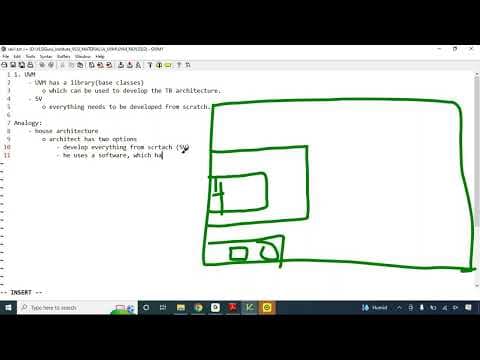
9-week course provides participants with in-depth exposure to UVM constructs and complex TB development using UVM.
Next Batch
1-1 Dedicated Mentor Support
24/7 Tool Access
Multiple Mock Interviews
Industry Standard Projects
Support with Resume Update
UVM Course Overview
UVM training is a 9 weeks course provides participants with in depth exposure to all the UVM constructs using practical use case examples. Course includes 15+ assignments covering all the constructs in depth.
Course also includes multiple hands on projects based on APB, AHB test bench development. Also includes TB development for AHB interconnect model.
- AHB Interconnect verification project used as reference design to learn UVM & OVM
- AHB Interconnect will be verified from scratch while teaching all aspects of UVM
- What is UVM? Need for a methodology?
- How UVM evolved?
- OVM, AVM, RVM, NVM, eRM
- UVM class library
- Classification of base classes in various categories
- OOP basics
- Encapsulation
- Inheritance
- Polymorphism
- Parameterized classes
- Parameterized macros
- Static properties and static methods
- Abstract classes
- Pure virtual methods
- How above aspect correlates with UVM implementation.
- UVM Class Library, Macros, Utilities
- Detailed overview of important UVM base classes, Macros and Utility classes.
- UVM TB Architecture
- Setting up a UVM based testbench for APB protocol from scratch.
- Significance of uvm_root in UVM based testbenches.
- run_test, how it starts whole TB flow.
- Command line processor
- Reporting classes
- Uvm_report_object
- Uvm_report_handler
- Uvm_report_server
- Detailed examples on use of methods in these classes.
- Objections
- UVM Factory
- Configuration DB, Resource DB
- Detailed usage of both data bases.
- How config_db is related to resource_db?
- Using config_db to change the testbench architecture.
- TLM1.0
- Push
- Pull
- FIFO
- Analysis
- Complex example on AHB to AXI transaction conversion.
- Simulation Phases
- UVM common phases
- Scheduled phases
- Sequences, Sequencers
- Default sequence
- p_sequencer
- m_sequencer
- Test case development
- Different styles of mapping testcase to sequence
- Using default sequence and scheduled phases
- Using sequence start method
- Configuring TB Environment
- Advanced aspects of developing a highly configurable test bench environment.
- Concept of knobs of test case scenario generation
- Using top level parameters to control the overall TB architecture
- AHB Protocol and AHB UVC development
- Coding from scratch with detailed explanation of each aspect.
- Setting up a highly configurable UVC to meet different TB requirements.
- Different testbench component coding
- Monitor
- Coverage
- Scoreboard
- Checkers
- Assertions
- Different styles of sequence development
- uvm_do
- start_item and finish_item
- Using existing sequences
- Sequence library
- Creating complex test cases using sequence library
- Virtual Sequencer, Virtual sequences
- Different types of sequences used in test benches
- Reset sequence
- Power up sequence
- Interrupt handling sequence
- DMA handling sequence
- FSM verification sequence
- Layered sequence development
- How to create multiple layers of sequences
- Creating complex test cases using layered sequences
- Virtual sequence library
- Creating test cases using virtual sequence library
- Synchronization classes
- uvm_barrier
- uvm_event
- Container classes
- Policy classes
- uvm_printer
- uvm_recorder
- uvm_packer
- uvm_comparer
- Comparators
- In order comparator
- Algorithmic comparator
- TLM2.0
- Blocking transport
- Non-blocking transport
- Register Layer development for USB2.0 core
- Note: Doesn't involve USB2.0 core verification
- Connecting multiple UVCs
- How to setup a complex testbench environment with multiple UVC's connected.
- uvm_heartbeat
- How to check test bench status using heartbeat
- uvm_report_catcher
- How to handle error testcases using report catcher
- Phase jumping
- uvm_domain


Key Features

Who All Can Attend This UVM Course?
This UVM functional verification course is ideal for fresh engineering graduates and entry-level professionals seeking to build a strong foundation in VLSI verification.Pre-requisites To Take UVM Advanced Course With Multiple Projects
- Basic digital logic design concepts.
- Familiarity with System verilog.
- Elementary understanding of programming concepts.

High Demand for UVM Advanced Course With Multiple Projects
Know about the Growing VLSI industry
Responsible for developing and executing verification plans for SoC/ASIC designs using UVM methodology. Works on simulation, debugging, writing testbenches, and ensuring design quality before tape-out.
Demand for Functional Verification Engineers is growing steadily with a 20–25% year-on-year increase due to the VLSI industry's expansion in India.
₹4 LPA
₹7 LPA
₹10 LPA
₹13 LPA


In the rapidly evolving field of semiconductor design and verification, the UVM Functional Verification methodology has emerged as a standard for creating efficient and robust verification environments. Pune, a hub for various technological advancements and home to many prestigious institutions, offers prime opportunities for individuals aspiring to gain expertise in UVM functional verification. This UVM Functional Verification Course in Pune is tailored to meet the needs of both beginners and seasoned professionals, making it a perfect fit for anyone looking to enhance their skills and career prospects in the EDA (Electronic Design Automation) industry.
At the forefront of this educational initiative is the UVM Functional Verification Training Institute in Pune, which is recognized for its comprehensive curriculum that covers both theoretical concepts and practical applications. Our training modules are designed by industry experts who bring real-world expertise and insights into the classroom. The course will include hands-on sessions leveraging advanced simulation tools and methodologies that ensure participants gain a profound understanding of UVM architecture, component interactions, and verification strategies. If you're looking to enroll in our UVM Functional Verification Online Training in Pune, we ensure flexibility so you can learn at your own pace, fitting your education into your busy schedule.
Opting for a Job-Oriented UVM Functional Verification Course in Pune means you are making a strategic decision towards a lucrative career. Our UVM Functional Verification Institute in Pune not only imparts technical knowledge but also prepares students for real-world challenges through industry-relevant projects and placements. The program emphasizes hands-on experience along with a placement guarantee, connecting graduates to top-tier companies looking for verified skills in functional verification. By participating in our training, you will be equipped with the skills needed to excel in job interviews, prepare for technical assessments, and ultimately land your dream job in the ever-growing field of semiconductor verification.
If you're on the lookout for a UVM Functional Verification Course Academy in Pune, our institute stands out with its commitment to quality education and career advancement. With dedicated faculty, an extensive network within the industry, and a focus on building practical skills, we empower our students to emerge as leaders in the field of UVM functional verification. Don't miss the chance to enhance your professional value and explore the boundless opportunities that await you in Pune's dynamic job market. Enroll in our Placement Guarantee UVM Functional Verification Training in Pune and take your first step towards a fulfilling career in EDA.

Explore a wide range of VLSI and Embedded Systems courses to get industry-ready.
50+ industry oriented courses offered.

Explore a wide range of VLSI and Embedded Systems courses to get industry-ready.
50+ industry oriented courses offered.