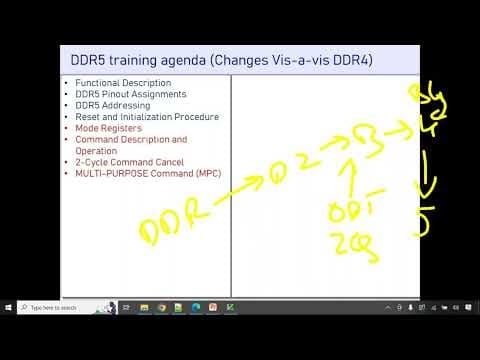
DDR is an essential component of every complex SOC. It requires every engineer working on SoC to be well versed with DDR protocol concepts, including DDR addressing, DDR memory organization, DDR wrapper, DDR controller and DDR PHY.
Next Batch
1-1 Dedicated Mentor Support
24/7 Tool Access
Multiple Mock Interviews
Industry Standard Projects
Support with Resume Update
DDR Training Overview
Unlock significant job opportunities by mastering DDR, a crucial component in modern SoCs. This comprehensive DDR Training course at VLSI Guru equips engineers with essential knowledge of DDR protocols, encompassing DDR controller, DDR PHY, and DDR memory fundamentals. The curriculum delves into DDR3 and DDR4 specifications, emphasizing timing diagrams, training sequences, controller design concepts, and PHY intricacies. Gain practical insights and a strong theoretical foundation to excel in complex SoC development and verification roles. Elevate your resume with in-demand DDR expertise.
DDR memory organization
DDR addressing
Channels, Ranks, Banks, Rows and Columns
DDR evolution
DDR interface signals
DDR commands, timing diagrams
DDR Mode registers
DDR clock frequency, limitation
DDR initialization and power up sequence
DDR Training: Write levelling, Read training, CA Training, ZQ Calibration
DDR calibration
ODT
LP, PC DDR's

Key Features
Who All Can Attend This DDR Training?
This DDR Training is ideal for professionals aiming to deepen their understanding of DDR memory architecture, signaling, timing, and protocol-level validation. It's especially valuable for those working in memory design, verification, or system integration roles.Pre-requisites To Take DDR Training
- Basic understanding of digital logic design.
- Exposure to basic memory concepts like SRAM, FLash, etc
- Exposure to basic hardware description languages (Verilog/VHDL - optional but helpful).
High Demand for DDR Training
Know about the Growing VLSI industry
Responsible for developing and executing verification plans to ensure the correct functionality and performance of PCIe interfaces in integrated circuits or systems. This involves creating test benches, writing test cases, and debugging issues.
The demand for verification engineers with specialized knowledge like PCIe is steadily growing, with an estimated 15-20% increase in related job postings over the last year.
₹4 LPA
₹7 LPA
₹12 LPA
₹15 LPA

Mode of Training
Next Batch
1-1 Dedicated Mentor Support
24/7 Tool Access
Multiple Mock Interviews
Industry Standard Projects
Support with Resume Update

- Learn in real-time with instructor-led sessions
- Flexible access from anywhere
- Recorded sessions available for revision
- Training on industry-standard tools
- Get certification after completion

- Self-paced learning as per your flexibility
- Industry-aligned learning modules
- Certification after course completion
- Access to structured video lessons and materials
- Track your progress step by step
- Access to learning materials for more than 1.5 years
DDR is an essential component in virtually every modern complex System-on-Chip (SoC). Expertise in DDR protocols, including addressing, memory organization, controllers, and PHY, opens up significant job opportunities for engineers working on these advanced systems. This training equips you with the crucial knowledge of DDR3 and DDR4, timing diagrams, training sequences, and design concepts for both the controller and PHY, making you a highly valuable asset in the current semiconductor industry.
Career Path
Learning Path

At VLSIGuru, we believe that education should lead to meaningful employment. Our training programs are designed not just to impart technical excellence, but also to bridge the gap between academic learning and industry demands. With a strong network of hiring partners and a proven track record, we ensure that our students are career-ready.
Placement Highlights
- Industry-aligned curriculum
- Hands-on projects and case studies
- Communication skills
- Resume building and interview preparation
- Technical and HR mock sessions
- Aptitude and domain-specific test series
- Regular drives and exclusive hiring events with partner companies
- Resume building and interview preparation

At VLSIGURU, we provide industry-focused VLSI training and guidance that helps students and professionals build strong technical skills and succeed in their careers. Our programs are designed to be practical, flexible, and aligned with current industry requirements.
Student Reviews


Frequently Asked Questions
- Course presentations for all topics
- Session notes
- Lab documents with detailed steps
- User guides
- Exposure to basic memory concepts like SRAM, Flash, etc
- Exposure to digital design concepts
Dedicated sessions planned to train student on Protocol specific TB component Coding
Each session of course is recorded, missed session videos will be shared
- Yes, You will have option to view the recorded videos of course for the sessions missed.
- You will have option to repeat the course any time in next 1 year.
- Yes, Course fee also includes support for doubt clarification sessions even after course completion.
- You have option to mail you queries.
- Option to meet in person to clarify doubts
DDR doubles data transfer rate by utilizing both clock edges, significantly boosting memory bandwidth and system performance. Our training dives deep into this core principle, equipping you with essential knowledge for high-speed designs.
Key features include high speed, low power options (LPDDR), large capacities, and efficient data transfer mechanisms. Mastering these through our course opens doors to designing cutting-edge, power-efficient systems.
Data is transferred in bursts on both clock edges, managed by intricate command and address signaling. Our practical sessions demystify this process, enabling you to effectively analyze and design memory interfaces.
Precise clock signals synchronize all operations, and techniques like clock enable control power states. Understanding clocking, a core focus of our training, is crucial for high-speed signal integrity.
DDR uses Banks, Ranks, and Channels for parallel access, maximizing data throughput and efficiency. Our comprehensive modules break down this organization for optimal memory system design.
DDR means Double Data Rate, offering double the data transfer speed of SDR for the same clock frequency. Learn how to leverage this fundamental advantage in your designs with us.
Banks are independent arrays, Ranks are simultaneously accessed chips, and Channels are parallel communication paths. Our course provides a clear understanding of these for efficient memory utilization.
Reading involves activating a row (RAS#), then a column (CAS#), with data transferred after a latency. We'll guide you through the timing intricacies for effective memory access design.
CAS Latency is the delay before read data becomes available; lower CL means faster performance. Our training emphasizes understanding and optimizing timing parameters like CL.
DDR training compensates for signal skews at high speeds, ensuring data integrity. Our hands-on labs cover essential techniques like Write and Read Leveling.
ZQ calibration matches DRAM impedance to the bus, improving signal integrity and reliability. You'll learn its importance and implementation in our detailed modules.
DDR4 offers higher speeds, lower voltage, and increased capacity. Our course covers the evolution, equipping you with knowledge of the latest standards.
ODT integrates termination resistors within the DRAM, reducing signal reflections for better signal quality. We'll explain how ODT enhances high-speed memory interfaces.
The typical phases are Activate, Read, and Precharge, each with critical timing parameters. Our training provides a clear visual and conceptual understanding.
Become the highest-paying VLSI engineer!
Join Hands with VLSIGuru Now

Become the highest-paying VLSI engineer!
Join Hands with VLSIGuru Now